

It is Friday, a Friday, unlike the ones we left behind, as the rumors of wars and ground being shaken in Ukraine have made us all ponder on the preciousness of life.
As my heart has been heavy for our friends in Ukraine and I pray for them and their country, I cannot stop thinking about the only answer to a world that is hurting: Jesus.
Interestingly enough that this past Christmas as we were planning to do a digital outreach in Ukraine, Kejdis and I several times felt compelled that we had to focus on this theme: Jesus Prince of Peace. What else than peace do we long for in war?
Our personal experience with war
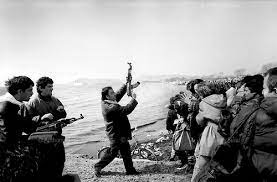
We have experienced war in two dimensions in our lives. The first time was in 1997 when Albania woke up to an armed civil conflict that escalated to a national level and took the country to an emergency state for one year. All foreigners and embassies were evacuated, missionaries included. Very few of them sent their family away but they stayed in the country to care for the flock. The airport and the public transportation were closed. All cities were locked, and you could not travel anywhere. Families were separated and there was no internet or cell phones at that time to know how they were doing. Shooting would be heard throughout the whole day and night.
All shops got closed, there was a shortage of food. More people died those months than during the first and second war in Albania.
Rudina did not see her family for several months, she could not call them, they could not call her. How did we know they were doing ok? If the news on the main TV station did not mention their name among the lost lives, we knew they were ok. Every night we would go to bed thanking God for protecting us that day and praying for safety, every morning we would thank Him for keeping us alive and ask Him for the grace that was made new that day.
The second war we experienced but from a different level was the war in Kosovo in 1999. We both served at the refugee camps and would assist hundreds and thousands who would cross the country’s borders daily. We heard terrible stories and met many families who had lost everything. The magnitude of pain was enormous. Many of us got trained on how to assist and counsel people in this type of crisis. In July 99 when the war stopped, Kejdis went to the city of Gjakova and Prishtina, with a team to assist people and help with relief work. After that trip, he decided to join the first Albanian team sent that September to serve in Prishtina.
It took Albania and Kosovo two years to get back to some normality, but a longer time to recover from that. God used even such tragic events in several ways:
- To strengthen the Albanian believers. Our hearts were turned to Him in fervent prayer. The church started to boldly organize prayer meetings.
- The work of the Gospel expanded as believers had unusual peace and hope amid the crises that others did not have, we went out to share the Gospel
- The evacuation of the foreign missionaries pushed Albanian young Christian leaders to take leadership, like an eagle pushes her little ones to fly. The first generation of Albanian Christian leaders were raised and refined through that difficult time.
- Mission expanded to surrounding nations where there was a great need for Christian workers. Many missionaries that were evacuated moved to Macedonia or other countries and started a ministry there. Our first missionary trip as Albanian staff happened that very spring as we went to Izmir in Turkey for our Spring project. I remember arriving at the Tirana airport and officers and other workers staring at us trying to understand why we returned to the country, when we could flee and save our lives
- For Kosovo, the mission work was opened and bloomed starting from the refugee camps in Albania all way to their country. Because they saw the true body of Christ responding quickly by assisting them in all ways, their hearts got tender to hear about Jesus, who was missrepresented to them before.
- Before the war there was only one church with Albanians in Prishtina, and may be another one in Gjakova. After the war, man churches started all over Kosovo.
- There were people who came to Christ and later on joined our movement and were sent to serve in difficult countries like Turkey or serving among Muslim Albanians in Macedonia.
Forward this situation to what is happening to Ukraine today. Even though the scenario is very different from the crises in Albania in 97, but similar to what Kosovo went through, there are many things in common as facing death daily, the need for hope and comfort, the need for safety, the fear of losing your loved one, separation from family and friends, being moved from your place and living under stressful conditions, dealing with a shortage of food, electricity, money, etc.
Amid that though God is at work and has plans that we might not be able to see right now. In our trust in His Sovereignty and everlasting love, we can have the assurance that He is using this war and crises for something bigger. Thus let us pray with hope and confidence in His sovereignty and goodness.
How do we position ourselves to align with His work?
Can we start with asking in prayer for God to open our eyes to see His work amid war?
A gift to connect in real-time
Compared to our situation in 1997 in Albania and 1999 in Kosovo, the internet has enabled information in real-time. That has helped us to pray daily for specific prayer requests, families and people by name, and even seeing their pictures. We know in real-time when they need something and can connect them with those who can provide shelter for them or assist them on their arrival at the border of one of the neighboring countries.
The Internet has also made it possible for the global church to mobilize prayer and aid in real-time. We are now part of praying groups that are updated regularly, we can connect from different parts of the world through zoom to pray together and intercede for our brothers and sisters caught in the war and their people, their country.
We can connect with our friends there to ask them how they are and praise God they are alive and safe, keep praying for them, sending words of comfort and encouragement so they know they are not alone but part of a body that cares for and loves them.
This is a tremendous gift to be able to show love, care, and support in real-time.
A gift and responsibility
Yes, there is a gift that God has given us in this wild and very dark place at times that we call digital space: the speed of communication to reach someone in real-time and in a personal way.
This gift though comes with a high responsibility on how we communicate so we stay true to who we are in Christ and bless those with whom we interact daily.
The challenge for us as Christians in times of political and social crises is to find the balance between being true to who we are and at the same time ministering to people who share different views or values. As humans living in this world, we might not be able to remove ourselves from what is happening around us, but we can control the way we respond to it by operating on a different spirit.
There is an increase in social pressure in social media that calls for you to identify your convictions or state where you stand: are you with us or against us?
Sometimes the conversations move to debates and it gets really messy and tense. Often times that is the reason why many decide to stay away from social media, because of how toxic it becomes especially in times of political crises. You post something that you think is ok and have no political connection, but it triggers someone else on another side of the world to blame you for being on a certain side. It is not easy to find the balance and this struggle might force us to abandon the battleground instead of learning to fight better for the sake of the lost souls there.
We need wisdom on how to effectively use this gift of no-border communication.
Here are some of the principles that we have found helpful and include in our training for better serving when you deal with a hostile response:
- Remember who you are and to whom you belong. You are a son or daughter of the Most High. You are an ambassador of Christ. You have the mind of Christ dwelling in you.
- Remember who is the true enemy. “For we do not wrestle against flesh and blood, but against principalities, against powers, against the rulers of the darkness of this age, against spiritual hosts of wickedness in the heavenly places”. Galatians 6:12
- Our weapons are different: we fight by praying, by blessing, by turning a blessing for an offence, we do not pay evil for evil, we do not need to prove to others that we are smarter or have the best argument. We don’t need to win a conversation. We are called to be peacemakers. “Do not be overcome by evil, by overcome evil with good” Romans 12:21
- Focus on prayer- care -share. Behind every screen is a real person, who has lost his way and needs Jesus. He or she is speaking out of the values of the kingdom of darkness as they don’t know better, we have been there before but have been brought into the Kingdom of Light- thus speak life. “A gentle tongue is a tree of life” Proverbs 15:4. I like another version that says: “A healing tongue is a tree of life”
- What if we fail? Confess your sin to God, repent and ask to be filled with the Holy Spirit. Ask God to help you be wise and use your fingers to type words of blessings and life.
What about you, what have you found helpful especially during intense political or social crises to reach out to others in the digital space?


