


Let me introduce you to a conversation on the Friends’ group. How would you explain what is going on here?
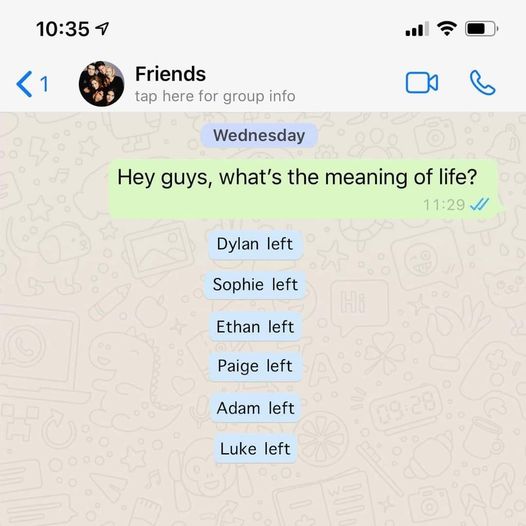
Let us look at it again. What new insights do we gain? What happened that Dylan, Sophie, Ethan, Paige, Adam, and Luke left the group?
Rewind to the time I became a believer. This would be quite a normal and engaging question to ask, but now it looks like it is not as engaging as it used to be.
One of the frequent questions that our staff and volunteers are asking is: How do we effectively follow up with people? What works?
Something has changed. It is not anymore as easy to engage people in Gospel conversations and to effectively follow them up.
The world has changed and because of that, the approach to evangelism and discipleship has changed. Internet and technology have contributed wildly to this change globally. Because of the internet, the spread of philosophies and ideologies is faster than at any other time. Exposure to different philosophies and ideologies has challenged many people to reconsider what do they really believe. This has not spared even those who come from very strong religious backgrounds.
Today there is a growing religion that has greatly been influenced by the internet, known as the religion of the “nones” – not affiliated to any religion. And the number of “nones” is growing primarily in the biggest cities of the world where you have a more heterogeneous religious composition.
Accept it or not, the internet is becoming the educational authority of the masses. You can not hinder or control a member of your church or small group to not be part of whatever groups he likes to be part of or follow any church they would like to follow online. That means that the chances for them to be exposed to all types of teachings and doctrines are wide open. I believe that this calls for us to be even more committed and intentional in our presence on the internet, by bringing solid and good content. If the dark is thicker how much more do we need to bring there the light. If we abandon, resist, or delay to bring the truth and light, then someone else will continue to influence people and drag them even to greater darkness and bondage.
What does it take for us today to close this gap?
Reaching people in the internet era requires from us a different approach
Let us go back to the first picture. What happened that Dylan and the others left the conversation?
Most of the Christian materials used online for evangelism or discipleship are designed for a post-Christian culture – meaning that the authors assume that nearly everyone holds the shared belief about a sacred order – that there is a God, an afterlife, a standard moral truth, and a sense of sin. But the “nones” and the late modern culture are not considering and even rejecting the idea of a “sacred order.”
Today the world we are living in is more a secular world than anything else. And this is primarily because of globalization, the growth of the cities, and as we already mention the impact of the internet and social media worldwide. Today, a young Hindu in New Delhi (if you scratch him a little bit) has the same belief as a young man in Paris who has strong secular views of the world.
To effectively engage people and especially those in the cities we really need to recalibrate our evangelistic efforts. We need to be better learners of the changes happening globally in order to better target and reach them. We need to learn to ask the questions the young generation is asking and tailor our evangelistic and discipleship efforts accordingly. Using post-Christendom materials would not get us very long. Our apologetics needs to change and address a secular viewpoint. Things related to identity, relationship, GOD, morality, sex, etc. Here are some categories secularism is teaching people that we need to redeem:
- Identity: “You have to be true to yourself.”
- Freedom: “You should be free to live as you choose, as long as you don’t hurt anyone.”
- Happiness: “You must do what makes you happiest. You can’t sacrifice that for anyone.”
- Science: “The only way to solve our problems is through objective science and facts.”
- Morality: “Everyone has the right to decide what is right and wrong themselves.”
- Justice: “We are obligated to work for the freedom, rights, and good of everyone in the world.”
- History: “History is bending toward social progress and away from religion.”
How are we adjusting our evangelism and discipleship to effectively reach young people?


